Sunday, April 23, 2017

Week Thriteen


This past week has been filled with an immense amount of work as well as learning in order to further our study of marketing as well as our Smart Projects. Tuesday's class focused on the former while Thursday's focused on the latter.

Logically, I will begin with Tuesday. We began this class by furthering our discussion of the communication process. This process involves how a sender creates and sends a message as well as how the receiver brings in and decodes the message. The communication process is shown below.
Image result for the communication process
To me, the most important part of the communication process is noise. This is anything on the outside that gets in the way of a person's ability to decode the message. This could be anything from other advertisements to news articles to other store displays. The idea of noise interested me so I decided to look into it more in depth. I discovered that there are really four different kinds of noise, physical, physiological, psychological, and semantic. The first two types of noise occur more often when the communication process is verbal. A physical noise might be loud music interrupting a conversation while physiological noise might be a speech impediment of one of the parties. However, since we were focusing on advertisements, I chose to focus more on the last two types of noise. 

Image result for silk cut cigarette ads
The first is psychological. An example of a psychological noise is a preconceived idea. This is something the consumer believes he or she already knows to be true. For example, last week we looked at the Burger King ad. Someone who believes McDonald's chicken sandwich is better is a psychological noise to the Burger King ad because they are less willing to hear the perspective that Burger King's could be just as good. Finally, semantic noise occurs when the two parties have different meaning systems. This occurred in class when we were looking at the British advertisements. Before we were told what the advertisements were for (a type of cigarette), we did not understand the meaning of the ad. This is because people in Britain have a different meaning or understanding of the humor used to create the ad. An example of one of the British ads is pictured to the right. This is a visual play on words (It's not over until the fat lady sings).

We also discussed the Old Spice TV ad shown below.
This commercial helped us to understand some advertising techniques. The first one is incongruity. By having the man in the commercial be in three distinct places (the bathroom, on a boat, and the beach/on a horse) Old Spice used incongruity. In other words, they associated things that don't usually belong together in order to make them more memorable. Additionally, the used the idea of primacy/recency. Primacy is the idea that a person will remember the first thing they see best. This may be why Old Spice chose to use an attractive man at the very beginning of their ad. The idea of recency is that someone remembers best what they saw most recently. This is why Old Spice puts the man on the horse at the end. If most people are like me, when they are thinking or talking about the commercial, or looking it up, they will think or talk about and search the man on the horse commercial rather than the Old Spice body wash commercial. 

Image result for promotional mixFurther along in the class we talked about marketing communications. The purpose of marketing communications is to inform, persuade, and connect. This is done through a promotional mix. A promotional mix focuses on creating "buzz." This is done through merchandising, campaigning, direct mail, advertising, public relations, sales, personal selling, and publicity. Sometimes, the differences between these things are hard to discern. The main definitions/differences we discussed in class are listed below, while the image to the left displays the idea of promotional mix.

  • advertising-mass communication, always positive
  • personal selling-to one person
  • public relations-within the firm, manage publicity
  • publicity-TV coverage, etc, out of firm's control, can be negative
We also discussed different types of media. The image below represents the three different types of media. Where owned meets paid can be considered enhanced engagement, paid and earned promotional interaction, and owned and earned organic interaction. Finally, there can be a fourth type of media called shared media. This is the word of mouth or buzz media that a company receives. All of these types of media are also part of the promotional mix.
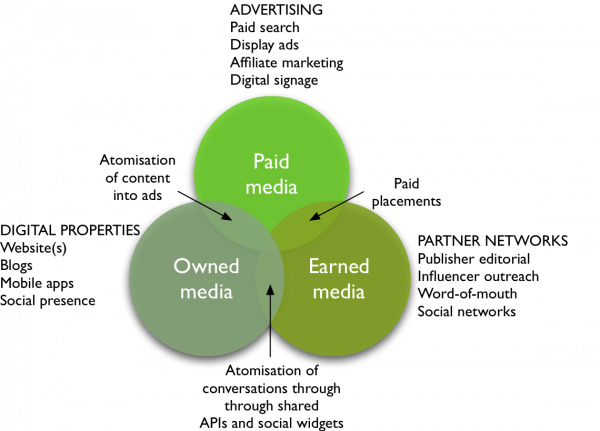
Image result for earned owned and paid media

Finally, we talked about the AIDA model. This is a model that helps companies reach their goals. It stands for awareness, interest, desire, and action. In order to be successful, an organization must create all four of these things, awareness of the product, interest in it, a desire to buy or invest in it, and the action of actually buying or investing. Examples of how each is created is listed below.
  • awareness-articles, ads, podcasts
  • interest-web content, newsletters, social media, email
  • desire-white papers, e-books, brochures
  • action-case studies, testimonial, data sheets, e-learning
Image result for aida model

Thursday's class was devoted to our Smart Projects. As the deadlines to finish our project approaches, more work needs to be done in order to be successful. However, my group has worked well together over the semester, and we are taking the final push to the end in stride. Thursday's class greatly benefited our group. Our original poster design was not very eye catching, and in general pretty boring. However, in my opinion, through our discussion with both Professor Spotts and Dr. Gettens, we were able to improve our poster drastically. The final product took a great deal of tweaking and attention to detail in order to finish, but we are proud of the way it turned out in the end. Our poster is pictured below. 

On Thursday we also discussed the elevator pitch. This is a 60-90 second discussion of our product in order to get a potential investor interested in it. We watched an example of a student doing a pitch, and were encouraged to start thinking about our own. The elevator pitch can be broken down as follows:
  1. 10-15 seconds to define who you are
  2. 45-60 seconds to describe what you do
  3. 10-15 seconds to state what you want from this person
The purpose of an elevator pitch is to engage the person you are speaking to in order to fascinate them by your product in a short period of time. Some tips for a good elevator pitch include not speaking too fast, containing your enthusiasm, and not using notes. Along with our value proposition, the elevator pitch is something each member of our group should be able to deliver flawlessly.


During this class and the last few days, we have also been working on our brand strategy memo. As our engineers are finishing up creating the final product, we are focused on creating a strong brand for our product. As we only have eleven days until the expo, our group is finally seeing or project come together, and we are excited to be able to share it with our peers and members of the WNE community.

Until next week!

-Kristen


Sunday, April 16, 2017

Week Twelve

Although we didn't do any activities that related to new content in the book this week, we were able to learn a great deal about our projects and the development of our products.

On Tuesday we had the opportunity to meet with our professor and discuss where we were in our customer discovery process. During this meeting, we talked about the insights we had gained, the surveys we had taken, and the summaries we would be coming up with. From our surveys, expert interviews, and market research we had three key insights discussed in our customer discovery memo. These were:

  1. There is definitely a need for this product (as shown by public safety response about the number of calls they get a day to unlock doors and market research saying the educational security market is growing 3.6% per year until 2020).
  2. Organized people will want to buy our product in order to stay organized (as shown by our target market survey and market research that says 34% of people consider themselves above average organizationally).
  3. Our target market should focus on young people, specifically between the ages of about 25-54 (as shown by our market research because they have the highest propensity to buy organizational products).
On Thursday we had the opportunity to meet with the engineers in a combined classroom. Throughout the class, we did many activities that helped us think about our product in terms of our customers. The first thing we did was a customer journey map. In this process we talked about what happened before, during, and after the customer experienced the painpoint we are trying to fix. Our journey map is pictured below.
Through this process we identified a couple of emotions that our customers would experience. These include anxiety, panic, stress, and frustration.


Image result for empathy mapAs a continuation of this, we created an empathy map. An example of an empathy map is pictured to the right. The feelings and emotions we used were mentioned above. The most important defining word we decided on was roommates because our customers seemed to be reliant on their roommates to remember their keys or let them in when they were locked out. Some thoughts and beliefs we identified were "this won't happen to me" and "I don't need help staying organized." Finally, some actions and behaviors we thought were important were being in a rush, throwing your keys down when you enter your room, and leaving too close to class time. This helped us get a better idea about our customers' interaction with our product.


We also talked about our value proposition. This is basically a short statement about our product so people know what it is and become interested in it. Additionally, it is something that our entire group should memorize for the Expo. It should say how our product solves the problem, what benefits we will provide, and why we are different from alternatives.  The elements of a value proposition are shown to the left. Our first draft value proposition is written down; however, we are looking to edit it in the coming days.

Finally, we briefly talked about developing a buying persona and our posters for the expo. A value persona is a description of what our average customer would look like. This includes their age, activities/interests, income, residence, and any other personal qualities that could influence their buying behavior. My group is very excited about the development of our poster. We feel as though our concept with keys and doors will lend itself to having an extremely creative poster design.

In general, this week was all about our customers for our projects. We were able to learn a great deal about what our customer looks like and what they are looking for. This has helped us to get an idea of what we will talk about to people at the Engineering Expo, and how we can get our product to be of interest to customers. Overall, we are looking forward to the final weeks of this project and being able to share it with our fellow students and faculty at the Expo!!

Happy Easter!!

-Kristen

Sunday, April 9, 2017

Week Eleven


This week's class focused on supply chain and distribution. I found this discussion interesting because it had been hard for me to tell the difference between the two.

On Tuesday, we talked about what a supply chain does. In general, a supply chain is responsible for:

  • assembly of raw materials
  • customer relationships
  • order fulfillment
  • production
  • sourcing
  • logistics
One thing we talked about in great detail was logistics and the inability to have complete disintermediation. This is because a company will always struggle to do everything better than they could have someone else do it for. For example, Fresh Patch may have been really good at marketing their product to their target market, but not as good at growing the grass. For this reason, they have someone else grow the grass so that they don't have to spend as much time on it in order to get the high quality product.
Image result for amazon

Additionally, companies like UPS, FedEx, and Amazon are examples of successful logistics organizations. These companies have made logistics the only thing that they do, and have made a great deal of money in doing so. Take Amazon for example. The reason that Amazon has become so popular is that they are able to store and distribute products for relatively cheap. As their name has caught on, people have begun to build trust in that brand making Amazon successful at selling products from companies we might not otherwise buy from.

Image result for 50 oz jar of picklesWe also talked about pickles and toilet paper. Basically, we were discussing how big box stores like Sam's Club can afford to sell their products at a lower price. The reason is that their target market is not actually regular people. Ordinary people don't NEED to buy a 50 oz jar of pickles. However, their target market is small businesses such as restaurants who need larger quantities of items but not enough to buy directly from the producer. Therefore, Sam's Club can sell 50oz jars of pickles to these companies and make money purely due to the fact that they will have to buy more than one, and will most likely keep coming back. Additionally, places like Walmart can then sell those products in smaller packages, such as 8 rolls of toilet paper. This is what is called "breaking bulk." This creates derived demand because the restaurant has a demand for the pickles in order to make sandwiches, hamburgers, etc for their customers.

On Thursday we discussed specific products and how they are marketed. The products and their product type are listed below

  • specialty: Jaguar, Rolex
  • convenience: Twinkies
  • shopping: Suit, TV
  • unsought: septic tank cleaning
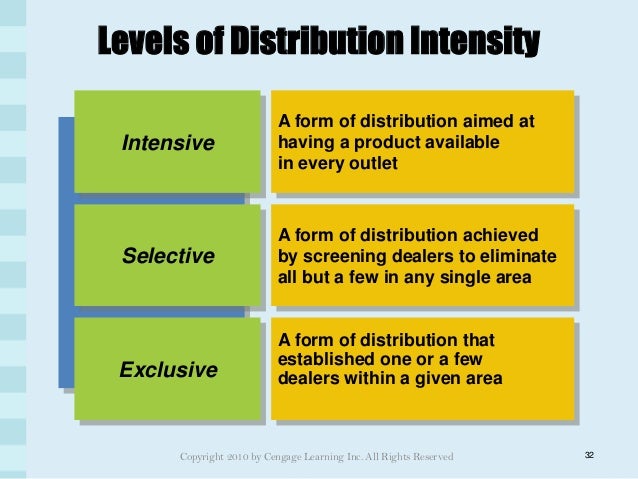
Image result for distribution intensityWe also talked about the different types of distribution intensities. The three different types of distribution intensities, along with their descriptions can be seen to the left. We then categorized each product type into the distribution intensities as follows:
  • intensive: convenience
  • selective: shopping
  • exclusive: specialty
We also talked about how unsought products are seen as selective intensity because of how often we see their advertisements, etc, but behave as exclusive intensity because when it comes to buying unsought products, there are often no other acceptable alternatives within a reasonable time frame. 
In terms of our smart project, our product would probably be classified as a shopping product which would mean we would want to focus on marketing it in a few different places, not too many or too few. Additionally this week we worked on putting our target market surveys into one document. Our group is looking forward to talking with our professor this week about the final steps in the customer discovery process! We are also very excited that we have less than a month left until we get to present our product at the Engineering Expo.

That's all for this week!

-Kristen

Sunday, April 2, 2017

Week Ten


Over the past week we have focused on a company that pitched their product on Shark Tank. This company is called Fresh Patch. They provide fresh patches of grass to customers in order for their dogs to use the bathroom and play on like they would outside when the outdoors is not available. The idea was created for customers who do not have a backyard, much like the creator of the product. Every two weeks a new patch of grass would be sent to the customer, as this product is mostly a subscription based product.
Image result for fresh patch

One aspect of Fresh Patch's marketing that we discussed in great detail was their target market. When we finished, we came up with a pretty full description of what Fresh Patch's customer would look like. They would be/have:

  • pet owners
  • limited access to grass
  • living in urban areas
  • busy
  • an emotional connection
The emotional connection is extremely important for this product because if the owner does not feel guilty about not having space for their dog, they would not be willing to pay $25 every two weeks in order to bring in grass for them.

We also talked about the competition that Fresh Patch might have. One of their biggest competitors would be pee pads. Pee pads are pieces of fabric that are put on the floor in a home and used for the dog to go to the bathroom on.
Image result for pee pad
Above is an image of a dog on a pee pad. Additionally, synthetic grass could be a competitor to Fresh Patch because it could be used in place of fresh grass. Finally, Fresh Patch has a patent on their grass patch which an undisclosed company was infringing on. This could also be a competitor if they figure out a way to get around the patent, or find another alternative to Fresh Patch.

We also focused on Fresh Patch's income statement. On Tuesday, we went over a basic income statement. This covered how much revenue the company made ($1,000,000) their costs of goods sold ($5/product), their variable costs (shipping-$11/product, average), gross profit (revenue minus variable costs and cost of goods sold), operating expenses (owners salary and website maintenance), and net income (gross profit minus operating expenses). At this time we also discussed Fresh Patch's break even point. The equation for break even point is below

BE=Operating Expenses/(price per product-(cost of goods sold + variable costs))

In order to break even, Fresh Patch would need to sell 7,222 units.

On Thursday, we focused on breaking down the income statement based on trial versus subscription users. At first, we assumed that trial users accounted for 75% of sales because they accounted for 75% of users. This led us to believe that the trial users provided the company with more money. However, a better assumption to be made would be that the trial users each only bought one unit of the 40,000 the company sold. This results in the subscription users accounting for most of the sales of Fresh Patch (96%). 

What I realized through this exercise was that what assumption you make about the market is important in your analysis. The assumption you make can effect the way you market your product to consumers so you have to be careful in making that assumption so you don't mislead yourself or your company. Thus, it would be important for Fresh Patch to focus on trying to convert some of the trial users to subscription users because the 550 trial users they have accounted for so much of their sales so far. 

We also furthered our discussion of pricing by applying some of the concepts of discounts to Fresh Patch. For example, we decided that in order to increase subscription use Fresh Patch could offer a discount on the product when bought as a subscription rather than individually. They could also discount the product in the summer when the weather is not so menacing and people would be less likely to keep their subscription. By discounting the price, Fresh Patch may be able to keep more subscription users over the summer months.
Image result for seasonal discounts
Lastly, we talked about the market size for Fresh Patch. Considering they have only had 2,200 people try their product and have made $1,000,000 in sales, Fresh Patch obviously has the ability to make a large amount of money. This is especially true considering there are over 400,000 people who fit Fresh Patch's target market living in the United States. We also decided that Fresh Patch could focus their marketing towards regions in the north such as Philadelphia, New York, Boston, and Chicago because they are the ones that will be effected by cold weather. The people living there might not want to take their dogs out when it's cold so Fresh Patch would be a great option.

Clearly, Fresh Patch has done some things right seeing as they have so much in sales. However, they could also improve on some aspects of their business in order to make more money. This includes reducing their shipping costs ($14 to the east coast) and increasing the number of trial users. Overall, I enjoyed looking at marketing through the Fresh Patch lens.

Until next week!

-Kristen

Sunday, March 26, 2017

Week Nine


Although it's been two weeks, and spring break went by too fast, it's good to be back here on the blog! This past week in marketing, we talked a great deal about pricing, as well as structuring our survey for our smart project!

Tuesday was a great opportunity for each group to meet with our professor and talk about the survey we each had developed for our project. For my group in particular, this meeting really opened our eyes to designing our survey in an effective way. It helped us to come up with questions that would give us the information we really wanted, rather than just yes or no answers. Below are some of the changes we made:


  1. Instead of jumping right into questions about organization, we are now starting by having our subjects describe what they do when they enter and leave their rooms.
  2. Do you hang your keys up? → Do you have a special place for your keys?
  3. How often do you lose your keys? → Do you lose your keys? How often?


These are just some of the changes that we made in order to improve our survey. As a group, we are now looking forward to asking people these questions, and many more, in order to gain insight about our market and where this product could potentially go!

Thursday's class was specifically structured around pricing. I enjoyed the way the class was set up because it made the time go by quickly and allowed us to apply the pricing techniques to the projects we are working on.

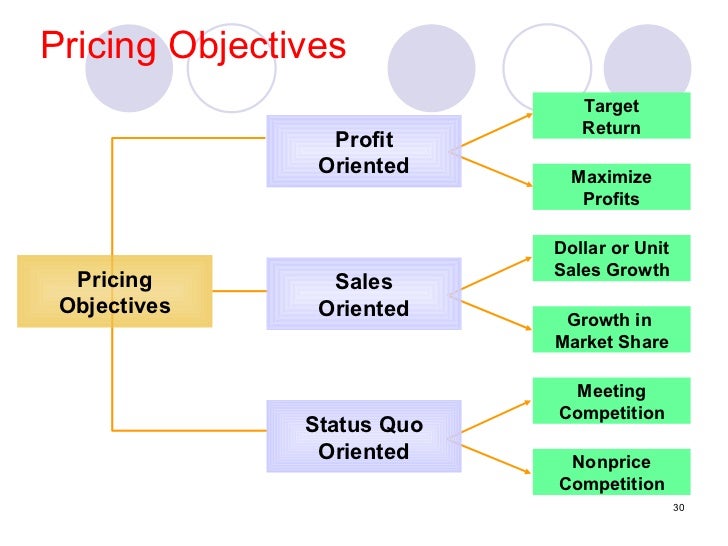
One topic that we talked about was pricing objectives. The three types of pricing objectives are shown below.


Image result for pricing objectives
My group decided that we would focus on a sales oriented pricing objective especially when our product was new to the market because it would help us to focus on getting our product out to as many people as possible. 

Image result for price penetration, price skimming, status quo pricingAdditionally, we talked about pricing strategies. These tend to go along with pricing objectives; however, they are different in the sense that a pricing strategy will help the organization reach their pricing objective. The pricing strategy that corresponds with a sales oriented objective is penetration pricing. This type of pricing sets the product price low at first in order to gain market share and may increase it over time. The other types of pricing strategies are shown to the left. Price skimming is a strategy that aligns with the profit objective because it allows for a company to set prices high in order to make money. Lastly, status quo pricing aligns easily with the status quo objective in order for an organization to meet their competition when it comes to prices and making money.

One other aspect of pricing my group thought about a great deal in relation to our product was discounts and price bundling. Price bundling occurs when the company packages two products together and offers a discounted rate. The example below shows this occurring with luggage. Clearly, the price to buy the two products together is lower than the price to buy them as separate entities. Unfortunately, my group decided there would not be a great way for us to use price bundling. We felt as though there was nothing we could sell our product with to make it more appealing and allow for a discounted rate.

Image result for price bundling

However, we decided that there were two types of discounts that could work well with our product. The first would be a bulk discount if we are selling directly to universities. In this way, if a university were to buy a certain amount of our product they would get a discount. For example if they buy 500-1000 they might get 5% off, if they buy 1000-1500 they might get 7.5% off and so forth. We also thought we might be able to offer a seasonal discount if we were selling directly to consumers. Therefore, if the product was bought right around the time the school year starts it might cost $25 but if it was bought in March it might cost $20. 

Some other pricing tactics that I found interesting this week that we did not discuss included:

  1. Single price tactic: pricing all goods and services at the same price (ex. dollar store)
  2. Flexible pricing: different customers pay different prices for same product
  3. Odd-Even pricing: when odd numbers are used to represent a bargain while even numbers represent quality (ex. $99.95 vs. $100)
  4. Leader pricing: pricing the product near or below cost with hope that the buyer will make other in-store purchases
Keeping it short and sweet this week! Until next time!!

-Kristen


Saturday, March 11, 2017

Week Eight


Crazy to believe we are already halfway through this semester! The past two months have flown by!! Over this past week, I've realized just how much I've learned about marketing so far. I'm excited to be able to put all of that together on one page in my mid-semester mind map. However, for the purposes of this post, I will focus just on what I learned over the last week.

On Tuesday our Smart Project groups had the opportunity to meet with our professor to discuss how our projects were going. I think the best part of this meeting was that our eyes were opened to some potential information sources we would not have thought of otherwise. For example, we were advised to talk to the head of facilities as well as public safety in order to learn about how many people actually get locked out of their rooms and if our product would be feasible for a university to purchase for students. We also were reminded to take a second look at our logo in order to make it eye catching and stand out to our consumers. Below is a picture of the current logo we are working on.
Additionally, during this class we were able to talk about our survey questions. Through this discussion we came up with many more potential questions to ask the people who will take our survey. This helped us to think about many different questions that might not be so obvious at first but could provide us with useful insight into how to make our product successful. Finally, we discussed our value proposition canvas. This relates the product to the consumer in order to eliminate the gap between the two. During our discussion with our professor, I realized just how important it would be to get the engineers involved in this process. Having them understand the way our customer will view the product will help them build the product to ensure it is well suited to their wants, needs, and fears. It also allowed us to think about certain features we may have forgotten as well as consider each aspect of the canvas from a different perspective. All in all, Tuesday's class helped our group progress in our project immensely.

On Thursday, we continued our discussion about products. However, this class focused on two major concepts, diffusion and innovation and product life cycles. To me, these are two of the most important concepts in marketing.

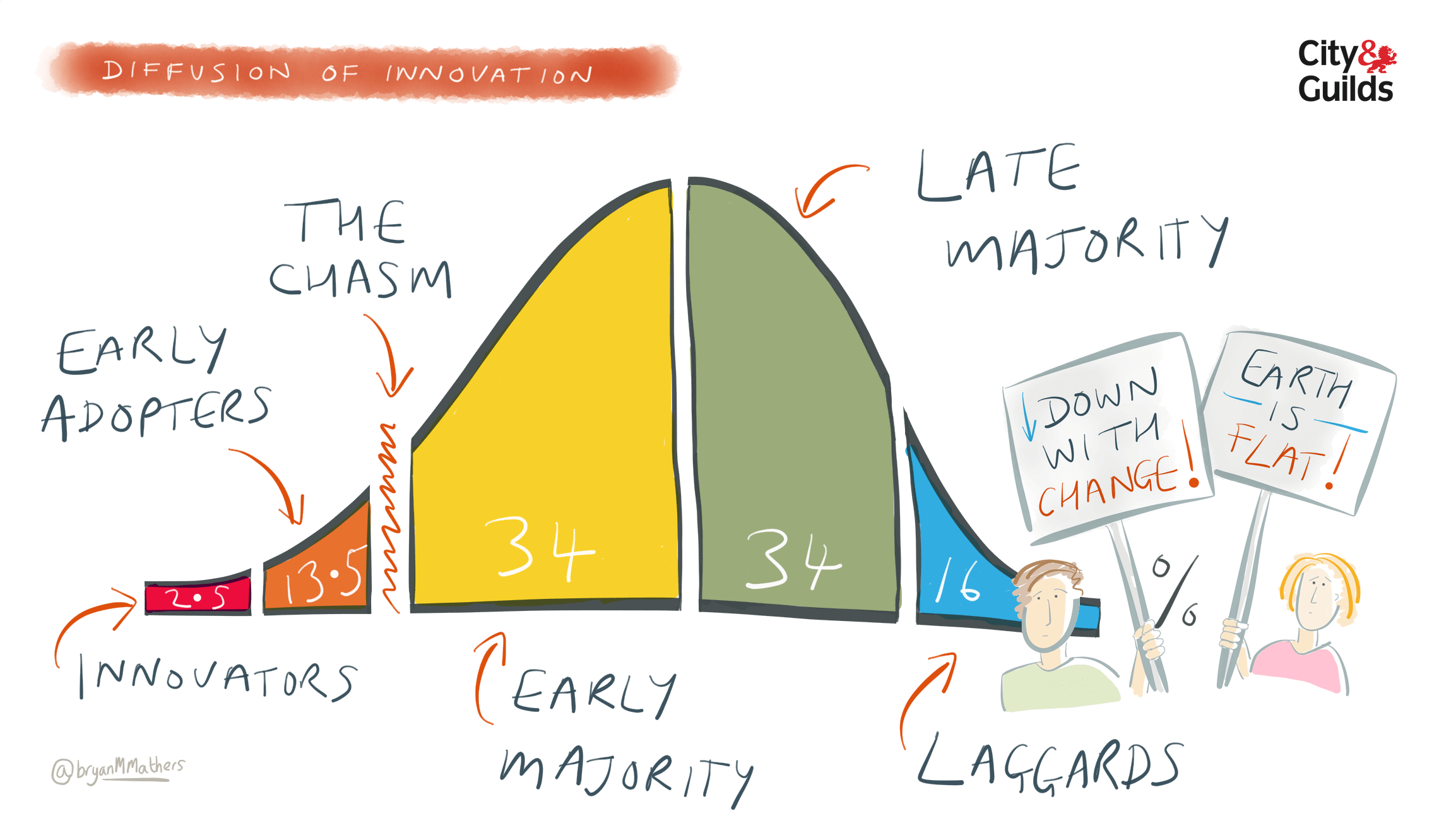
Image result for diffusion and innovationFirst, diffusion and innovation is all about how a product is introduced into the market. In other words, it is who buys the product over time until it is spread throughout the population of the market. The image to the left displays this theory. The innovators drive change, are adventurous, and are risk takers. They tend to buy a product because of the enjoyment they will get from it. Early adopters embrace change, are influencers, and are inspired by the newness of the product. They often buy a product because of the social acceptance it will give them. The early majority accept change, are practical, and go along with the world around them. They tend to buy a product because it will be useful to them. The late majority are skeptics, need proof of validity, and jump in. They often buy products out of necessity and only after others have it. Finally, laggards do not accept change, like tradition, and reluctantly join in. Often, they buy products because they have no other choice. The most important aspect of this theory is "the chasm". A product mucstget over the chasm, or get the early majority to start to purchase it, if it wants to succeed.

We were able to apply this theory to our Smart Projects by deciding what each group would be relative to our product. My group thought that high tech universities with a lot of money would be our innovators, our early adopters would be those who consider themselves influencial within the university world, and the early majority would be universities such as our own who see the practicality of the product. Our late majority would be more traditional universities with less money, while our laggards would be old school, classic universities who take pride in their rich history.

Image result for product life cycleThe other theory we talked about was the product life cycle. In general, all products follow the same life cycle. Right now, our products aren't even in the life cycle because they haven't been introduced or made yet, but they are in a "pre-introduction" stage. Introduction is when the product is first sold in the market. Often times, although sales are growing no profit is being made. The growth stage is when sales grow at an increasing rate, creating profits for the organization. The maturity stage is when sales still grow but at a decreasing rate. At this time, competitive or promotional pricing as well as intense advertising is often used in order for the organization to keep gaining money. The final stage is the decline stage. Sales begin to fall and competitors begin to take over.

What I found interesting in this discussion was that some products never quite reach the decline stage. One example discussed in class was the iPhone. The iPhone as a product may never decline, at least not in the time we can think about right now. Although certain versions of the iPhone have clearly reached, and surpassed, the decline stage (can anyone say iPhone 3G?!?!), the entire iPhone product most likely won't ever reach that stage. This brings up the distinction between a product and a product line which we talked about last week. Either way, it is important to recognize that not all products have the same exact life cycle, but that this idea can be used as a general outline for thinking about products within a market.

As I continue to learn more about marketing, I am looking forward to seeing the progress that has been made on our Smart Projects as a class. Additionally, I'm excited for the opportunity to connect what I've been learning to make a marketing plan for a product that has been on Shark Tank. Although I don't know what product I will be using yet, I can't wait to continue to apply what I've been learning in and out of class to such a unique assignment.

Here's to spring break!! I'll be back with more in two weeks!!

-Kristen